
Want your inn, restaurant, or tour company to show up when travelers ask ChatGPT or AI Overviews where to stay and eat in Maine? Here’s how.

The Maine Tourism Business Guide to Generative Engine Optimization
Are you worried AI tools like Google AI Overviews, ChatGPT, or Perplexity are recommending the inn down the road instead of yours? Or suggesting another state for a destination wedding rather than Maine? Generative engine optimization, or GEO, helps your business appear in AI-generated answers, and gives you a shot at earning the next traveler who asks AI where to stay, eat, or book a tour in Maine.
If so, read on.
This isn’t written for big hotel chains with unlimited marketing budgets. It’s for the innkeeper, the restaurant owner, the tour operator…people who recognize that travelers’ search is changing, and want to stay ahead of it.
So, What is Generative Engine Optimization?
GEO is the process of making your business easier for AI platforms to understand, trust, cite, and recommend. It includes improving your website content, strengthening your online reputation, and earning mentions from credible sources: TripAdvisor, local press, and Visit Portland itself.
You might also hear it called AIO, AEO, or LLMO. They all point to the same thing.
Why Does GEO Matter to Your Tourism Business?
The way travelers plan trips is changing. A growing number of people now ask AI chatbots questions they used to type into Google: “best waterfront restaurant in Portland Maine for a rehearsal dinner,” or “family-friendly inn near Acadia with a pool.” That’s a full sentence, not a keyword.
AI-powered search is still small compared to traditional search, but it’s growing fast, and the people using it tend to be further along in their decision, closer to booking. If AI doesn’t know your business exists, or gets the details wrong, you’re invisible at the exact moment someone’s deciding where to spend their vacation dollars.
SEO vs. GEO: What’s the Difference for Tourism Businesses?
SEO gets a traveler to click your website. GEO gets your business mentioned or recommended inside the AI’s answer itself, sometimes without a click at all. Both overlap, and both are important to your business, but GEO puts more emphasis on clear entities, credible claims, and reputation signals at third party sites.
| Traditional SEO | GEO | |
| The Goal | Get the searcher to click your link | Get cited or recommended in the AI’s answer |
| How People Search | “Best lobster roll in Portland, Maine” | “Where should I get an authentic lobster roll in Portland that’s not too touristy?” |
| What AI Values | Links, page speed, keyword placement | Concrete details, named credibility, structured info |
| Key Sources | Your website, directories | Plus TripAdvisor, Reddit, local press, Visit Portland |
| Traffic Impact | High volume, lower intent | Lower volume, high intent: these are near-booking travelers |
It’s important to understand that GEO is a new discipline. There’s limited long-term data, the platforms change constantly, and results vary. Your mileage, as they say, may vary.
What AI Platforms Should Tourism Businesses Care About?
GEO is a fragmented landscape, and your next guest could be using a variety of different platforms. It also depends on how much of your traffic is business-related vs. vacationers.
Some people search with traditional LLMs (Large Language Models) like ChatGPT or Claude that use both their training data and web searches to answer questions. Others use AI-powered search engines like Perplexity. And likely we all use AI features that are now part of traditional search, like Google’s AI Overviews that are appearing on over half of all searches.
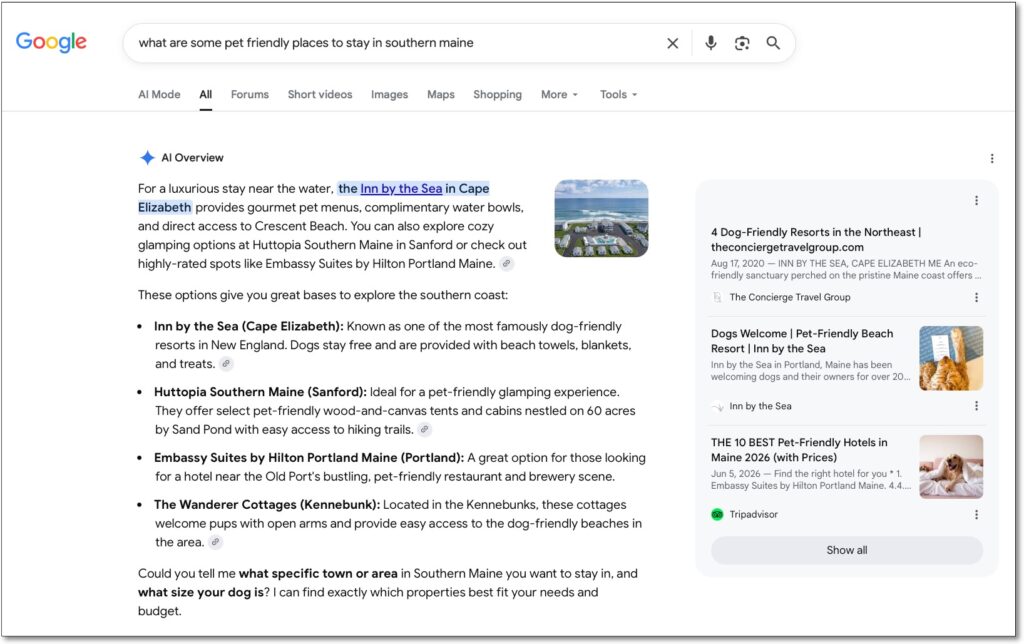
- Google AI Overviews shows up on more than half of searches now, including a lot of “things to do in Maine” queries.
- ChatGPT is increasingly where people plan trips.
- Perplexity is popular for research-heavy travel planning, and it shows clickable source links prominently.
- Microsoft Copilot is more used for B2B, but that could mean corporate event planners.
- Claude has smaller mainstream search share but growing use for detailed trip planning.
How to Rank Well in AI Search?
Trick question, as AI doesn’t “rank” websites the way that Google does. But you can improve your chances of being mentioned and recommended by these platforms by making your lodging, restaurant, or tour company easier to understand, and back up claims with data, reviews, media mentions, and other online sources.
Do You Even Show Up in AI? Here’s How to Check
Two questions worth asking any AI platform:
- “What do you know about [your business name]?”
- “What are the top five [restaurants/inns/tour companies] in [geographic area]?”
If AI doesn’t mention you, or gets your offerings wrong (calls your farm-to-table restaurant a “casual seafood spot,” say), that’s your starting point.
Important Note: LLMs are probability engines, not consistent databases. Ask the same question twice and you may get different answers. That’s normal. The goal isn’t a consistent answer, it’s showing up often enough that you’re in the rotation whenever someone turns to AI.
GEO Strategies for Your Website
Back Claims with Numbers: Don’t say “cozy waterfront dining.” Say “Our deck seats 40 and looks straight out over Casco Bay, no binoculars required.”
Cite Credible Sources: If the Press Herald, Down East Magazine, or a TikTok influencer has recognized you, say so and link to it. Borrowed authority is still authority.
Add Real Guest Quotes: A guest review that says exactly why they loved your inn is more useful to an AI than your own marketing copy. Pull the good ones onto your site.
Don’t Bury the Lede: Answer the traveler’s implied question in your first sentence. “Portland’s only rooftop oyster bar” beats “Welcome to our restaurant.”
Phrase Headers as Questions: “How much does a Maine lighthouse boat tour cost?” beats “Our Pricing.”
Name Your Entity Early: State clearly, near the top of the page: who you are, what you offer, who it’s for, and where you’re located. “flyte new media” is an entity. So is your inn’s name, “Portland, Maine,” and “waterfront dining.” AI connects these concepts when they sit near each other.
Technical Basics: Make sure your site isn’t JavaScript-dependent to the point that AI crawlers see a blank page. Add schema markup. Don’t block AI bots! Think of them as ambassadors for your business.
Off-Site Signals That AI Platforms Trust
Keep Your Profiles Current: Google Business Profile, Facebook, TripAdvisor, and your Visit Portland listing should all say the same accurate thing about your hours, offerings, and location.
Get on “Best Of” Lists: When someone asks Claude “best places to stay near Old Port,” it synthesizes existing lists. Being included in “Top 10 Portland Inns” roundups matters more than it used to.
Earn Reviews Where Travelers Actually Look: TripAdvisor, Google Reviews, and OpenTable feed AI’s understanding of your business as much as they influence human travelers.
Get Featured, Get Cited: Local press, travelogs, and Down East Magazine mentions all become sources AI draws from when recommending Maine businesses.
How to Measure GEO Results
GA4’s AI Assistant Channel: GA4 now tracks referral traffic from recognized AI platforms like ChatGPT, Gemini, and Claude. It’s not the only signal, but it ties directly to your bookings and your bottom line.
Track Responses Over Time: Once a month, ask a few AI platforms what they know about your business and who they’d recommend in your category. Log the answers. You’re watching for trends, not perfection.
Your Booking or Contact Form: Add an open text field, not a dropdown, asking “How did you hear about us?” When someone writes “I asked ChatGPT for a place to stay near Acadia and you came up,” that’s proof that your GEO is working.
Why GEO Isn’t Replacing SEO or Word of Mouth
Most travelers still plan trips through a mix of traditional search, social media, referrals, and old-fashioned word of mouth. GEO adds a new channel, it doesn’t replace the ones you’ve already built.
And if you’ve invested in SEO, that work already benefits your GEO. AI platforms often turn to the web when they’re not “confident” in an answer.
The tourism businesses that get ahead of this now will have the same kind of advantage the early SEO adopters had twenty years ago. If you want a better sense of how AI currently sees your business, and what to do about it, reach out to flyte new media today.
Rich Brooks is founder and president of flyte new media, a digital agency in Portland, Maine, that’s been in business for nearly 30 years. flyte offers branding, web design, and digital marketing service to businesses in Maine and beyond. He is a nationally recognized speaker on AI, digital marketing, and entrepreneurship.
He founded The Agents of Change, an annual conference and weekly podcast that focuses on digital marketing topics from AI to SEO, neuromarketing to conversion rates.
Rich is the author of The Lead Machine: The Small Business Guide to Digital Marketing, a popular and well-received book that helps entrepreneurs and marketers reach more of their ideal customers online.
He appears regularly as the “tech guru” on the evening news show, 207, which airs on the NBC affiliates in Maine. He has also appeared in Inc. Magazine, The Huffington Post, FastCompany.com, CNN.com, the Social Media Examiner, and many other news sources for stories on digital marketing.